By Kathy Hieatt | 06/19/2026
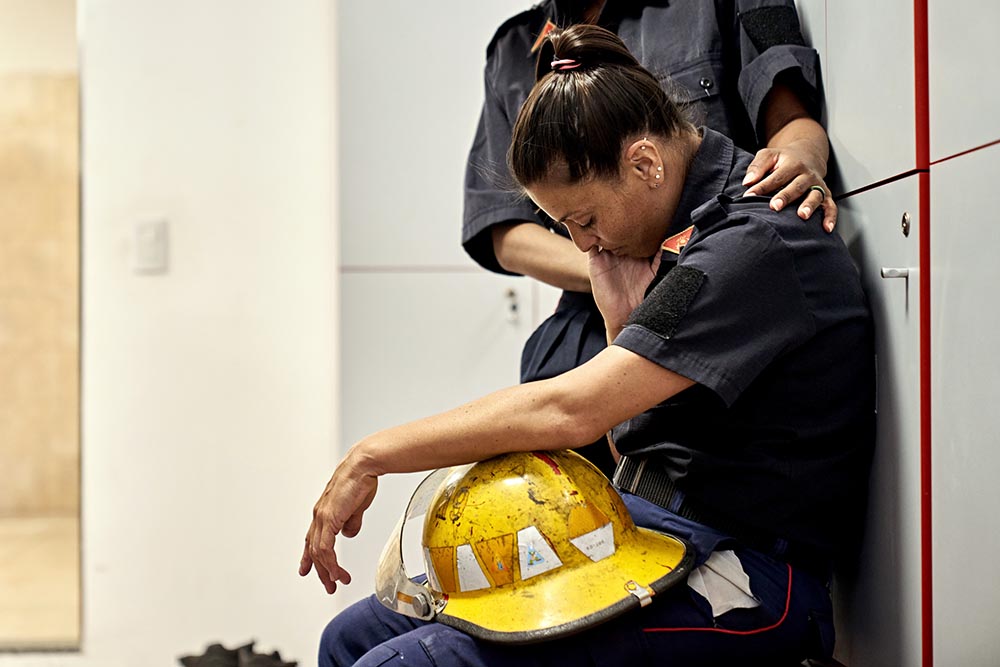
Whether it’s putting out a house fire, responding to a fatal car crash, or stopping an active shooter, first responders are regularly exposed to traumatic events on the job. You run toward danger, put yourself in harm’s way, and answer the call when your community needs you most.
The job can take a toll, even for the strongest among us. That’s why it’s critical to prioritize your mental wellbeing. To effectively serve your community, you must first take care of yourself.
A Struggle for 1 in 3 First Responders
Over 80% of first responders experience traumatic events on the job, and one in three will develop post-traumatic stress disorder (PTSD), totaling 400,000 first responders nationwide, according to the Institutes of Health in California. That’s significantly higher than the general population, where the incidence of PTSD is one in five.
That puts first responders at risk for depression, anxiety, substance abuse, and even suicide. According to the Institutes of Health, PTSD symptoms can include:
- Nightmares or flashbacks of distressing events
- Chronic pain
- Sweating
- Jittering
- Headaches
- Dizziness
- Chest pain
- Irritability
- Angry outbursts
- Sleep problems
- Difficulty concentrating
PTSD is a treatable condition, but many first responders are reluctant to seek help because of the cost, the time, or the perceived stigma, according to the Institutes of Health.
Dr. Chuck Russo, Department Chair of Criminal Justice at American Military University (AMU), witnessed these struggles firsthand during his 26 years as a police officer in central Florida. Police officers, in particular, may fear looking weak or being passed up for promotion if they receive mental health treatment, he said. As a result, untreated chronic stress compounds over time, impacting the officer and their family.
“We need to find better ways of dealing with it and better ways of assisting our officers because things are not getting better,” Russo said. And it’s not just police. The same applies for many first responders.
In fact, emergency medical services (EMS) professionals have the highest incidence of PTSD among first responders–affecting 15% of medics, according to the Institutes of Health.
Ending the Stigma
The good news is, attitudes are slowly shifting, Russo said.
In the past, seeking mental health treatment could end your career, Russo said. And suicides were concealed, labeled as accidents, he said.
“Years ago here in the U.S., it wasn’t open to talk about it, it was hidden,” Russo said. “Now we’ve gone beyond that and we’re actually openly talking about it in hopes of preventing future incidents.”
Employers are doing their part to improve resources and support through Peer Support Teams and Employee Assistance Programs. Peer Support Teams in particular are essential for first responders, who are often more comfortable talking to their peers than a stranger.
“Peer Support Teams are a major step forward in combating the burnout and mental health issues,” Russo said. “Officers are far more likely to reach out to those they trust with their lives.”
The same holds true for other first responders.
Community is also crucial to combat stress and burnout, which has been exacerbated in recent years by understaffing, especially in law enforcement, Russo said.
Finding Support in the AMU Community
Higher education can provide community and a support system, especially at a university, such as AMU, that prioritizes mental health. In addition, AMU students and faculty bring career-relevant knowledge from their experience in law enforcement, corrections, fire, EMS, and more.
AMU promotes student mental health and wellness with programs such as TalkCampus, a no-cost peer-support network available online 24/7/365. TalkCampus enables students to connect, discuss, and receive support for mental health issues, including stress and anxiety. They can even participate anonymously.
AMU also offers University Chaplains, a Disability Services Accommodations team, and UWill, which provides same-day appointments with licensed therapists and wellness events.
Employers can facilitate these connections by partnering with universities like AMU, which provides employees with special benefits and services.
Agencies should also consider more regularly rotating people out of difficult positions, such as homicide and special victims units, and avoid frequent changes from day to night shifts to help staff normalize their schedules and family lives, Russo said.
“They could have a much more stable family life, much more stable social life, which helps to reduce stress. It can help somebody with if they want to go back to school, to earn that degree,” Russo said. “So there are things that an agency can do proactively to help the officer reduce some of these stressors, reduce some of the burnout, and some of these things really don't cost a ton of money.”
‘It’s What You Do. It’s Not Who You Are’
First responders share a unique dedication to their fields because they’re committed to helping others–but they also have to remember to help themselves.
“It’s just what you do. It's not who you are,” Russo said. “Take care of yourself.”
You’re driven to protect, to serve, to make the world a better place. We’re driven to help you succeed. At AMU, we believe that higher education can unlock higher purpose and provide a supportive community that shares your struggles.
AMU offers 200+ programs–including criminal justice, fire science management, public administration, nursing, disaster and emergency management, and more. Online classes start every month, and emergency services professionals qualify for discounted tuition through our Everyday Heroes Grant.
Learn more at PublicSafetyatAMU.com.
Kathy has over 18 years of experience in journalism and public affairs. She writes print and digital content for first responder and military audiences in the B2B, B2G, and B2C sectors.