By Robbie Gould | 03/19/2026
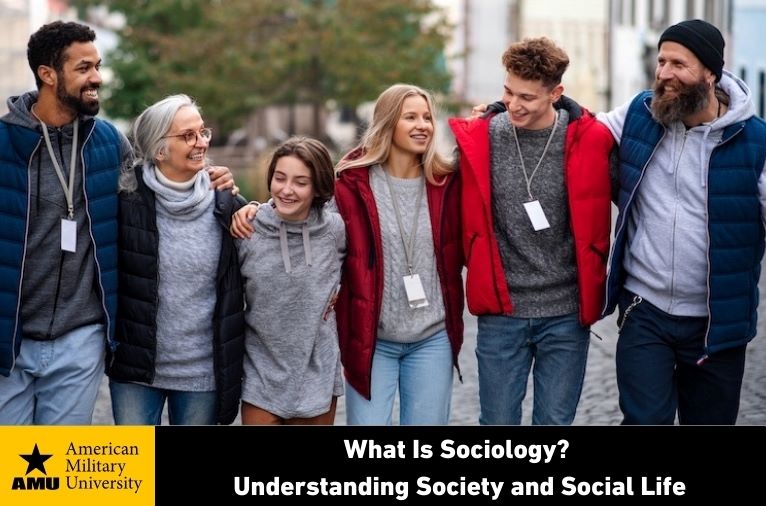
At a basic level, sociology is the study of social life and how people interact within the social world around them. When someone asks, “What is sociology?”, the answer usually involves understanding patterns and human behavior.
Sociology looks at how everyday interactions, relationships, and social structures shape behavior over time. Rather than focusing only on individual choices, sociologists investigate the broader social forces that influence how communities function.
By examining human social life, sociologists explore how people interact within groups, institutions, and communities. This perspective helps explain why certain social patterns remain stable and why others change; these changes in patterns and human behavior can occur slowly or very quickly.
Sociology as an Academic Field
Sociology is part of the social sciences, a group of disciplines that focus on how people live together and organize society. Unlike the natural sciences, which study physical or biological systems, sociology is a distinct discipline that studies social systems created through human action and interaction.
This field overlaps with other departments in academia, such as:
- Psychology
- Economics
- Political science
However, sociology approaches questions from a wider angle. For example, psychology often focuses on individual behavior.
By contrast, sociologists investigate how families, social institutions, and governments shape behavior and social processes in shared ways. This broader view makes it possible to see how society's norms, shared beliefs, and cultural practices influence people in different social situations.
What Sociologists Study
Because social life is complex, sociologists investigate a wide range of topics. They examine how groups form, how institutions operate, and how societies respond to change. Some common areas of sociological research include:
- Social class and social inequality
- Gender and identity
- Family relationships and intimate family life
- Religion and belief systems
- Education and schooling
- Law, crime, and organized crime
At first glance, these topics seem unrelated. What they share is a focus on social causes and consequences.
Sociology studies how social forces shape opportunities, behavior, and outcomes, often revealing patterns that are easy to miss in daily interactions. Through this work, sociologists help to explain both stability and transformation within societies.
The Sociological Imagination
An important concept in sociology is the sociological imagination. This concept encourages people to connect personal experiences to larger social structures and social processes. Sociological imagination also asks people to pause and consider how individual situations are shaped by forces beyond personal control.
For example, struggles related to employment, education, or family life often feel personal. Sociology asks different questions, such as:
- Are economic conditions involved?
- Do institutional practices play a role?
- Are cultural expectations or gender roles shaping these experiences?
Developing this way of thinking is central to sociological thought. It allows students to better understand their own lives while also gaining insight into the experiences of others.
How Sociologists Analyze Society and Its Social Structures
Sociology relies on research to understand social life. Sociologists use a scientific approach to gather information, analyze patterns, and draw conclusions about human behavior. This focus on evidence is what separates sociology from opinion-based explanations of society.
Research methods vary, depending on the question being studied. Sociologists may conduct surveys, interviews, or observations of daily interactions.
They also analyze social facts, such as demographic data or institutional records, as part of broader social research. These research techniques allow sociologists to examine social phenomena carefully and ethically.
By applying the scientific method to social research, sociologists can:
- Identify patterns
- Explore social causes
- Better understand how systems operate across different groups and societies
Sociological Theory and Early Thinkers
Sociological theory helps to explain why social patterns exist and how they change over time. Early sociologists developed many of the ideas that continue to shape this discipline today, often in response to major social changes such as industrialization, urban growth, and political transformation.
Theory and research work together in sociology. Theory helps guide the questions sociologists ask, while research helps test and refine theoretical ideas using real-world evidence. This ongoing relationship remains a defining feature of sociology as a discipline.
Sociology in Everyday Life
Although sociology often focuses on large social systems, it is closely tied to common culture and everyday life. Sociologists investigate daily interactions to understand:
- How social norms guide behavior
- How roles are learned
- How meaning is created through interaction
Simple experiences – talking with family members, following classroom expectations, or navigating workplace hierarchies – are shaped by social rules that people learn over time. Sociology helps explain how shared beliefs, social class, and common culture influence expectations and behavior in these familiar settings.
Looking at everyday life through a sociological perspective often reveals patterns people take for granted, encouraging a deeper understanding of the social world.
Why Sociology Matters
A systematic study of sociology matters because it helps explain social problems, social inequality, and social change. By examining social structures and systems, sociology provides tools for understanding challenges that affect societies.
For students, studying sociology under the guidance of sociology department instructors builds analytical and critical thinking skills. It encourages careful observation, thoughtful questioning, and an evidence-based approach to understanding social life, including social interaction and social movements. These skills are useful in many fields, such as:
- Education
- Social work
- Public policy
- Law
Understanding Social Change
Sociology is not only about describing how societies work. It also helps explain how societies change and why those changes matter. By studying institutions, social systems, and human interaction, sociology shows how social forces shape behavior over time.
As societies continue to evolve, sociology remains essential for understanding change and its consequences. This discipline offers insight into how people live together, how social systems adapt, and how informed social understanding supports thoughtful engagement with the world.
The Bachelor of Arts in Sociology at AMU
For adult learners who are interested in studying various aspects of sociology, American Military University (AMU) provides an online Bachelor of Arts in Sociology. For this bachelor’s degree, students can enroll in courses such as an introduction to statistics, an introduction to sociology, classical sociological theory, and contemporary sociological theory. Other courses include stratification and inequality, research methods for sociology, and social problems.
This B.A. in sociology also offers six concentrations to enable students to choose the concentration courses best suited to their professional goals. Students interested in learning more about potential career options can explore different career paths with a sociology degree.
For more details, visit AMU’s arts and humanities degree program page.
Note: This program requires the purchase and use of Statistics Package for the Social Sciences (SPSS). The University does not supply this software.
Robbie Gould is a staff writer for American Military University with a knack for creating compelling and effective content across multiple platforms. He holds a B.A. in English Studies and a minor in Marketing from the University of North Carolina at Charlotte, as well as an MFA in cinematography and film production from the New York Film Academy.
Robbie combines his passion for storytelling with a strong foundation in SEO and digital marketing. His expertise in crafting data-driven content has helped elevate brand identities and engage audiences, driving significant improvements in key performance metrics. He is currently pursuing an MBA at Boston University.